The Hidden Order Within: Understanding Coherence
What Is Coherence?
Have you ever watched light pass through a prism and seen it scatter into a rainbow?
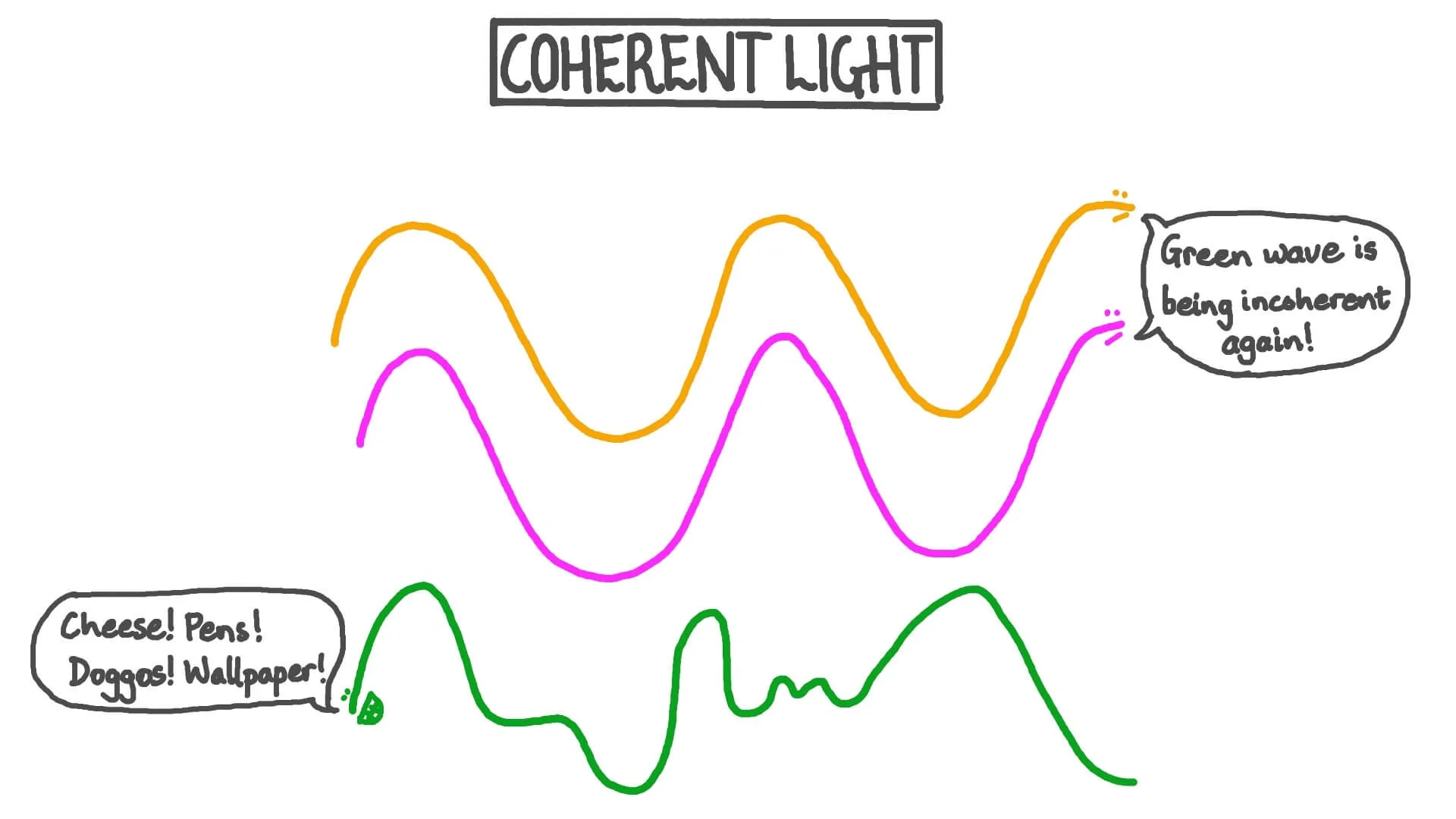
Ordinary light is incoherent — its waves travel in different directions, out of sync, each photon doing its own thing.
But a laser beam…? A laser is coherent. Same direction. Same frequency. Same phase. And because of that alignment, it can cut through solid steel.
Coherent light is a beam of photons (almost like particles of light waves) that have the same frequency and are all at the same frequency.
Only a beam of laser light will not spread and diffuse. In lasers, waves are identical and in phase, which produces a beam of coherent light.
Now ask yourself: what would it feel like if your inner world operated like a laser instead of scattered, fragmented rays?
This is what coherence means at its most essential — alignment. Not perfection. Not the absence of struggle. But the deep, felt sense that your thoughts, feelings, body, and actions are moving together, toward the same truth.
The Radical Idea at the Heart of Coherence Therapy
Bruce Ecker, co-developer of Coherence Therapy, made a discovery that quietly turned psychotherapy on its head.
He noticed something that most therapists were trained to overlook: your symptoms are not malfunctions. They are not bugs in the system. They are the system working exactly as it learned to work.
The anxious perfectionism. The emotional shutdown. The relationships that always seem to end the same way. These aren’t random. They aren’t illogical.
Deep beneath conscious awareness, they each carry a hidden, perfectly coherent logic — an emotional truth that was forged in the fires of early experience and has been faithfully, quietly running the show ever since. Like a script or code that’s outdated.
Ecker calls this the symptom’s pro-survival purpose.
The child who learned that being small kept an angry parent calm still lives inside the adult who shrinks in meetings.
The teenager who decided that love always leaves still writes the ending of every relationship before it’s even begun.
The symptom is not the problem. The symptom is a messenger — and it will keep knocking until someone finally opens the door.
What Sets This Apart From Traditional Approaches?
Most therapeutic traditions — cognitive behavioural therapy, behavioural conditioning, even many forms of medication — operate on a similar assumption: the symptom is the enemy.
The goal is to challenge it, reframe it, reduce it, manage it, or extinguish it entirely. And sometimes, that works.
But often, it doesn’t. Not at the root.
Because you can’t permanently overwrite a deeply held emotional truth simply by arguing with it.
You cannot think your way out of something you felt your way into.
The therapist becomes an archaeologist of sorts, gently helping you excavate the buried emotional learning that is generating the symptom.
Not to blame the past. Not to stay stuck in it. But to bring it into the light, where it can finally be seen, felt, and — crucially — updated.
This updating process is made possible by a neuroscientific phenomenon called memory reconsolidation.
When a deeply held emotional memory is reactivated in the presence of new, disconfirming experience, the brain literally reopens that memory for rewriting.
The old learning doesn’t get buried under new learning. It gets transformed at the source to update to a new truth - not based on cognitive distortion.
This is not suppression. This is not coping. This is liberation.
Coherence in Physics: The Universe Speaks First
Long before it entered the therapy room, coherence was a concept that physicists marvelled at.
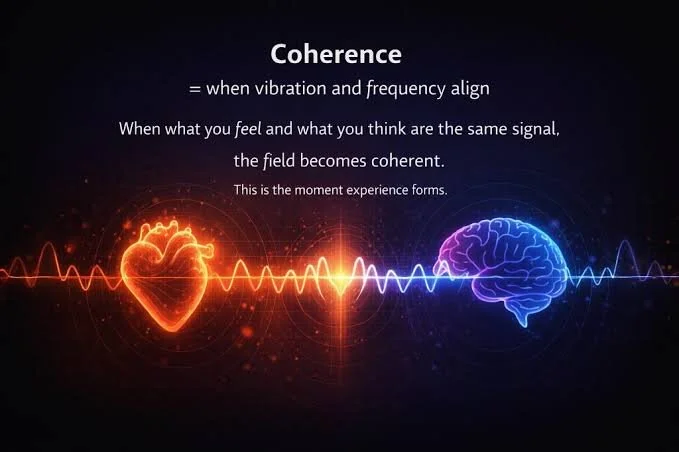
In quantum physics and wave mechanics, coherence describes the state in which waves — whether of light, sound, or matter — are perfectly correlated.
They move in harmony. Their crests and troughs align. And in that alignment, extraordinary things become possible: superconductivity, lasers, the very stability of matter itself.
The human heart, remarkably, is a source of electromagnetic coherence.
Research from the HeartMath Institute shows that when we experience states of genuine appreciation, love, or inner calm, our heart rhythm becomes measurably more coherent — smooth, sine-wave-like, rhythmically ordered.
This cardiac coherence then synchronises with the brain, the nervous system, and even — in close proximity — with other people’s fields.
You have felt this. You’ve walked into a room and picked up that something was wrong, before a single word was spoken.
You’ve sat with someone at peace and found yourself breathing more slowly. Coherence is not a metaphor. It is a measurable, transmissible state of being.
Coherence at the Level of Psyche and Soul
At the psyche level — the level of the mind and emotional history — coherence means that your conscious values and your unconscious emotional truths are no longer at war.
It means the part of you that wants deep connection and the part of you that fears it have finally met, spoken, and come to understanding.
It means you are no longer spending enormous energy managing, suppressing, or white-knuckling your way through your own inner life.
At the soul level — the deeper stratum of meaning, purpose, and identity — coherence is the felt sense of being fully yourself. Not the self that learned to perform, to shrink, to strive, to survive. But the self that existed before the world told you who to be.
There is a Sanskrit phrase: Tat tvam asi — “Thou art That.”
You are not separate from the ground of being. You are not a fragment that needs to earn wholeness. Coherence, at the soul level, is the direct, lived recognition of this — not as philosophy, but as felt truth in the body.
This is why coherence therapy, at its most profound, is not merely symptom relief. It is a homecoming.